Slot volatility is one of the key parameters that determines the behavior of a slot machine. In simple terms, it shows how often and in what amount winnings occur. Understanding volatility allows a player to choose a slot for their own strategy and budget, so it is important to understand “what it is and what it is eaten with” - we will talk about this further.
What are the types of volatility?
All slots are conventionally divided into three main categories:
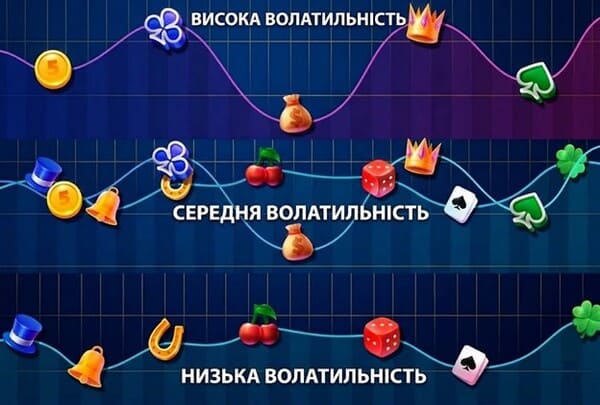
Low volatilitySuch machines give frequent wins, but their size is usually small. This is a good option for a long game without big risks;
Average volatility. Balance between frequency and size of payouts. The player receives both regular winnings and a chance for larger amounts;
High volatility. Wins are rare but can be very large. Such slots are suitable for those who are willing to take risks for the potential of a large jackpot.
How does volatility affect the game?

Volatility directly affects the behavior of the balance: at low - the balance changes slowly; at medium - there are fluctuations, but without sharp drops; at high - both quick losses and large gains are possible.
Volatility and RTP?
Many people confuse these concepts. This often happens to beginners. It is important to understand that these are not the same thing. In short, RTP shows, how much money is returned to players on average over the course of the game, and volatility is how exactly this money is distributed during the game.
How to choose a slot based on volatility?
Choosing a slot based on volatility is not about “like/dislike,” but a practical calculation based on your bankroll, playing style, and session length. The same slot machine can be comfortable for one player and unprofitable for another – precisely because of the different approach. What should you start from?

1. Budget
The key rule: volatility should match the size of the bank. In short, the smaller the bank, the lower the volatility should be. How it works in practice:
Small budgetIf you have a limited amount of money, high volatility slots will quickly eat up your balance due to long streaks without winnings. Here it is better to choose low or medium volatility to get frequent payouts and stay in the game longer.
Average budget. Allows you to combine. You can play medium volatility as a base and periodically enter high risk.
Big budget. Allows you to withstand drawdowns. In this case, high-volatility slots become a logical choice, because there is a margin for "expecting" a big win.
2. Playing style
It is important to understand what result you want to get from the process. There are three options:
The game "for a stable small plus." If stability and control are your goal, it is better to choose slots with low volatility. They offer frequent small wins, which creates a feeling of constant movement.
The game "for a big drift". If you are interested in big wins, even at the cost of frequent losses, then high volatility is suitable, but you need to be prepared for long "empty" periods.
Mixed approachMany players use a combination: the main game is medium volatility, and part of the bank is at risk.
3. Playtime
The length of the session greatly influences the choice, so this is something to consider as well. Again, let's consider three options:
Short sessions (15–30 minutes)You have few spins, so the chance of "expecting" a big win in high volatility is small. It is better to choose low or medium to get the result faster.
Medium sessions (30–90 minutes). The optimal option is medium volatility. There is a balance between the frequency of wins and the chance of something more.
Long sessions (1–2 hours or more). Here you can already consider high volatility slots. There is enough time to survive the drawdowns and wait for a big payout.
In general, it is recommended to follow the following logic::
- Small bankroll + long game → low volatility;
- Average bank + game balance → average volatility;
- Big bank + willingness to take risks → high volatility.
This approach allows you to not just choose a slot at random, but to adjust the game to specific conditions and goals.
Typical player mistakes
Many beginners misunderstand the principle of volatility, which leads to certain mistakes. These in turn often lead to a quick loss of money. For example, players:

- They think that "he hasn't paid for a long time - now he will definitely pay" − results in slots do not depend on previous spins, so the expectation of a “winning streak” is false;
- They choose high risk without sufficient bank − without a financial reserve, the player cannot withstand a drawdown and quickly loses his entire balance;
- They don't take into account the difference between RTP and volatility − a high RTP does not guarantee frequent wins if the slot has high volatility;
- They change slots too often − the constant change of games makes it impossible to understand their behavior and increases the chaotic nature of the results.
Can I determine volatility myself?
Volatility is not always stated openly, so players rely on indirect signs that can roughly determine the type of slot:
- Frequency of winnings − if payouts appear almost every few spins, this is a sign of low volatility;
- The presence of large multipliers − high odds (x50, x100 and more) are usually typical for high-risk slots;
- Bonus feature structure − complex bonuses with the potential for large payouts are more common in high-volatility games;
- Slot behavior over 50–100 spins − long streaks without wins with rare large payouts indicate high volatility.
Conclusion
Thus, the volatility of slots is not just a technical parameter, but the basis of the entire logic of the game. It determines the risk, style and dynamics of winnings. Understanding this indicator, you can consciously choose slot machines for your goals: stable play or a chance for a big win.